Preparing Homes for Severe Climates: Safety Measures to Implement Immediately - Severe Climate Conditions: Improvements in Home Safety Measures
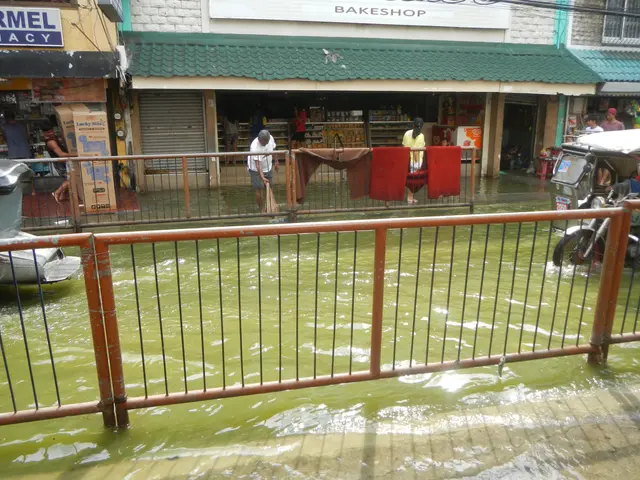
Catastrophic flooding in Bavaria and Baden-Württemberg, as well as nearby regions, resulted in numerous casualties and an estimated damage of 4.1 billion euros in both states, according to the Bavarian State Ministry of Finance and other sources. The German Insurance Association (GDV) estimates insured damages at around 2 billion euros, although it does not differentiate between the states.
The June flood was one of the most severe in terms of insured damages in recent history. Out of more than three million addresses in Baden-Württemberg, approximately 55,000 are at risk of flooding, with the majority located in the Rastatt district, the Main-Tauber district, and the Rems-Murr district.
Anja Kafer-Rohrbach, deputy CEO of the GDV, suggests that extreme weather events could become more common in Germany due to climate change. The association offers an online flood risk check to help homeowners and renters assess their risk.
Architect Sven Haustein of Sparkasse Schwäbisch Hall outlines measures for new buildings. These include site selection away from rivers, floodplains, or slopes, high-quality construction, secure roofing, sealed basements, optimal rain and wastewater management, and the use of smart technologies.
For existing properties, Haustein recommends retrofitting roofs, installing backflow preventers, improving landscaping, and using technological solutions such as automatic awnings and blinds that react to weather warnings.
Homeowners should be aware that standard building and contents insurance may not cover damages caused by flooding, landslides, snow pressure, earthquakes, or avalanches. Separate natural hazards insurance is required for such damage.
The flood disaster has renewed the debate about mandatory insurance against flood damage. The GDV reports that only about half of the buildings in Germany are protected against natural hazards by insurance. In Baden-Württemberg, this figure is already 94 percent due to historical reasons.
Nature-based solutions, climate-resilient design, spatial planning, flood-resistant materials, elevated foundations, improved drainage systems, adaptive planning, and funding for climate adaptation projects are being implemented to enhance house safety and reduce flood risks in Baden-Württemberg.
References:[1] Federal Ministry of Finance (BMF)[2] Spatial planning in Stuttgart[3] Guidance for local authorities on funding and financing for climate adaptation projects
- To mitigate the increasing frequency of extreme weather events in Germany due to climate change, policies focused on science-based environmental-science research, climate-change adaption, and the promotion of vocational training in areas like civil engineering and urban planning could be essential components of an employment policy, improving the nation's resilience to natural disasters.
- Amidst the discussions about mandatory insurance against flood damage, it would be advisable for EC countries to consider the importance of creating a continent-wide framework for environmental-science education, including vocational training programs in areas such as engineering and urban planning, to enhance each nation's capacity to prepare for, manage, and recover from climatic disasters, contributing to sustainable economic growth and societal wellbeing.