Rapidly developing lake on the brink of overflowing in the near future.
In the Lötschental valley of Switzerland, danger looms once more after a recent glacier collapse. Debris from the collapse has dammed the Lonza river, forming a lake with rising water levels. The authorities fear the lake may overflow within hours, posing a threat to nearby villages.
The impressive debris pile, which resulted from the glacier collapse, is putting increasing pressure on the surrounding area. The lake, which has grown rapidly in size, experienced an hourly rise of up to three meters at its peak. Fortunately, the rate of rise has slowed as of the evening reporting, though the lake remains a cause for concern.
"Our primary concern is to anticipate the evolution of this situation and ensure the safety of those living downstream," said Christian Studer of the Natural Hazards Service during a press conference in Ferden, Lötschental. Specialists are working tirelessly around the clock to predict the outcome, utilizing both experience and computational models.
In response to the potential impending disaster, 16 residents of downstream villages Wiler, Kippel, and Blatten were evacuated on Thursday. A further two individuals were evacuated from Blatten.
While a catastrophic flood wave rushing through the valley is deemed unlikely, it cannot be entirely ruled out. According to Stéphane Ganzer, a member of the Walliser canton government, this scenario could become a reality if the pressure from the incoming water of the Lonza causes the debris pile to give way. Temperatures of 20 degrees are forecast for the valley on Friday, which would further accelerate snow melt and increase water volumes.
Studer, however, maintains that a slower outflow is more likely, with the lake gradually emptying over time. He notes that the gentle slope of the debris pile provides favorable conditions for such an outcome. Furthermore, the lake water could potentially erode the deposited material and carry it down the valley, although this process is expected to occur gradually. Experts believe the material will eventually be stopped at Ferden's reservoir and dam.
Meanwhile, the situation on the mountain remains precarious. The threat of further rockfall from the Kleines Nesthorn, with an estimated volume of hundred thousand cubic meters, looms large, as does the danger of debris avalanches on the opposite side of the valley. The stability of the debris pile itself is also uncertain due to the presence of ice and potential water pockets. Although army clearance teams are on standby, the area remains too dangerous for entry.
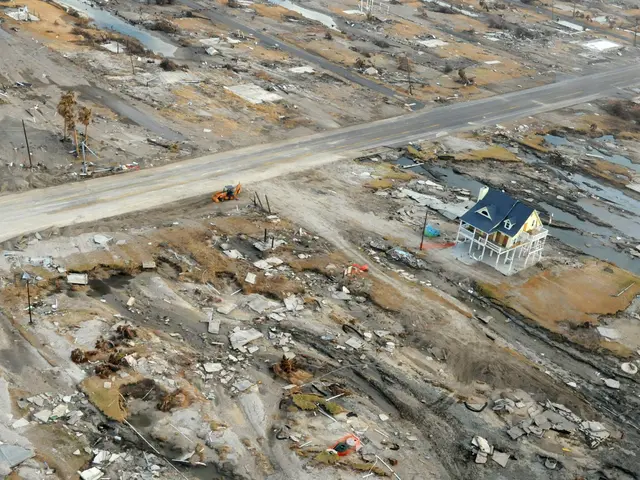
Despite initial sparing, houses in Blatten have been destroyed by the backed-up water of the Lonza. Drone images show parts of the village buried beneath a meter-high layer of debris. Blatten, the last village in the 27-kilometer-long Lötschental valley, is located at roughly 1500 meters, while the hamlet of Ried, just one kilometer before Blatten, is also affected.
Climate change, with its warmer temperatures, has been causing Swiss glaciers to decrease and become less stable for many decades. In the years 2022 and 2023, Swiss glaciers lost 10 percent of their mass, equivalent to the loss experienced between 1960 and 1990. These trends contribute to increased glacier instability and increased frequency of collapses, as seen in the recent event in Blatten.
The community is closely monitoring the lake in Lötschental, Switzerland, as it continues to pose a threat to nearby villages, with potential overflow within hours. Scientists are employing their expertise in environmental science and using computational models to predict the lake's evolution. The ongoing climate-change, fueled by increasing temperatures, has been identified as a significant factor in the decreasing stability and mass loss of Swiss glaciers, contributing to the frequency of collapses like the recent one in Blatten. The political implications of this environmental crisis are becoming more apparent as authorities work to ensure the safety of the affected communities and develop mitigation strategies for future events.