Germany Eyes Naval Mission to Secure the Strait of Hormuz Amid Shifting Priorities
German Navy's Elite Mine Divers Prepare for Potential Strait of Hormuz Deployment
Four German Navy mine clearance divers in a speedboat cut through the waters of Kiel's harbor basin. Clad in black neoprene suits, these soldiers belong to a small, elite marine unit—and they may soon be called upon in the Middle East, at least if the federal government's announcements are to be believed. According to officials, German forces could join an international mission to secure the Strait of Hormuz, including mine-clearing operations. How—or even whether—such a deployment will materialize remains unclear. That hasn't stopped the navy from showcasing its capabilities in advance.
In Kiel on Thursday, the Bundeswehr staged a demonstration of nearly its entire mine-hunting arsenal. Alongside the elite divers, a remote-controlled boat patrolled the harbor, designed to detonate naval mines in a controlled manner. Moored nearby were five minehunters, each equipped with underwater reconnaissance drones.
The navy actually has ten of these 600-ton, anti-magnetic steel vessels. But when asked how many are operational, Commander Inka von Puttkamer, head of the 3rd Minesweeper Squadron, casually referenced the navy's "one-third rule": roughly a third of its assets are always combat-ready. In other words, Germany currently has about three minehunters ready for deployment.
Both von Puttkamer and Navy Chief Jan Kaack emphasized that they stand ready should Berlin approve a mission in the Strait of Hormuz. However, they acknowledged that such a deployment would require reallocating resources from other operations. "If the political leadership decides we should participate, we can refocus our priorities," Kaack said, stressing the need to allocate limited resources strategically.
Little of this urgency was evident the day before, when Defense Minister Boris Pistorius unveiled the framework for a new strategic doctrine for the Bundeswehr. The SPD politician echoed a demand frequently made by Chancellor Friedrich Merz: "Our ambition—and it must be—is to build the strongest conventional army in Europe," Pistorius declared on Wednesday.
He identified the North Atlantic and the Strait of Hormuz as the "two poles" of potential Bundeswehr deployments. While Germany is already deeply integrated into NATO structures in the North Atlantic, Pistorius argued that the Strait of Hormuz is critical for upholding the international rules-based order. He was not referring to the illegal wars waged by Israel and the U.S. against Iran but rather to the risk of vital shipping lanes becoming "toll routes" for years to come. "That's why we naturally have a role to play there," he said.
Pistorius reiterated that any such mission would require a Bundestag mandate and an end to active hostilities in the region—a position shared by France and Britain, which first proposed the operation. Over the weekend, when the Strait of Hormuz briefly reopened, U.S. President Donald Trump reacted with fury, declaring that he had told NATO members they could "stay away" because they had been "useless" when needed in war.
The idea that a European mission off Iran's coast might convince Trump of the value of international cooperation appears lost on the U.S. president—especially since any operation in the region would depend on American intelligence.
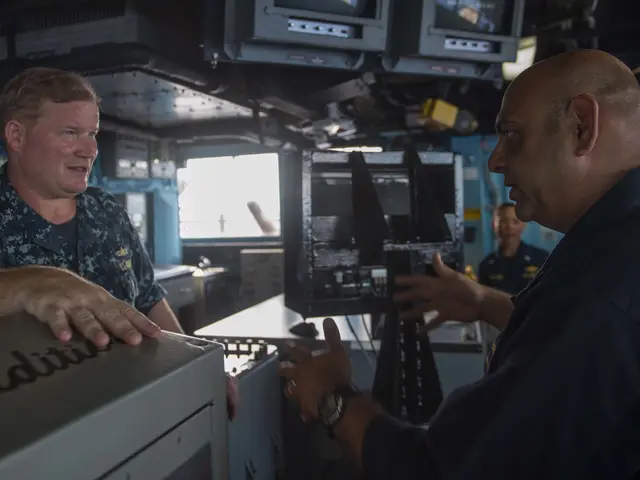
Back at Kiel's harbor, these geopolitical tensions seemed distant. The four mine clearance divers basked in the sun aboard their inflatable boat as a group of journalists boarded a nearby minehunter, where eager sailors demonstrated their high-tech equipment.
The ship's commander explains that the vessel can accommodate up to 44 service members. Like the German Navy's other minesweepers, the Sulzbach-Rosenberg is designed for operations anywhere in the world. On board, it carries drones that can either be controlled via cable or follow pre-programmed routes to detect naval mines. To avoid triggering detonations themselves, these minesweepers generate almost no magnetic field and operate with extreme stealth.
The crew also includes four combat divers, a standard complement for such vessels. They deploy when conditions—such as shallow water—make drone operations impractical. Trained to approach mines directly, these divers disarm their fuses, a high-stakes practice in which the German Navy has decades of real-world experience, having cleared unexploded ordnance from World War II in the North and Baltic Seas.
"If called upon, we're ready," says Fabian Scharf, head of the naval mine clearance diver company. According to Navy Chief Vice Admiral Jan Christian Kaack, Germany would redeploy a minesweeper from an ongoing NATO mission if needed, while a supply ship could be diverted from another operation in the Aegean.
Beyond the political debate over whether such a deployment might occur, countless technical challenges remain. Commander von Puttkamer frames the core dilemma with a rhetorical question: "How many mines does it take to block a shipping lane?" She answers immediately: "Not a single one." A well-placed headline alone, she argues, could convince the world of the threat. "That is the nature of mine warfare."