Troubled lake situated within Lötsch valley causes concern
Updated Situation in Lötschental: Draining of Stagnant Lake and Ongoing Risks
The stagnant lake formed following the glacier collapse in Lötschental, Switzerland, is experiencing a significant decrease in water level. This development comes as a relief to the local residents who remain vigilant, keeping a close eye on the weather forecast.
According to reports, the dammed mountain river, Lonza, is gradually carving multiple channels through the massive debris cone that wedges its bed. As noted by canton geologist Raphael Mayoraz during a press conference in Ferden, the water level behind the debris dam has dropped by approximately one meter.
Recent aerial footage shows floating barriers installed in the dammed water to obstruct flood debris and maintain the outlet's free flow. The initial water volume is estimated to be around one million cubic meters, which has now diminished to approximately 800,000 cubic meters [1].
Despite this promising development, Mayoraz warns of the potential dangers associated with impending rainfall and melting ice in the surrounding mountains. Such weather conditions could destabilize the debris cone, increasing the risk of debris flow and further endangering downstream communities.
The debris cone itself, composed of about nine million cubic meters of material, poses a significant concern to experts. Approximately one-third of this mass is believed to be ice, and its melting is an uncertainty [2]. The possibility of cavities forming within the cone and causing collapse is also a concern, as the cone is deemed extremely unstable.
The initial rockfall that triggered the catastrophe occurred from the roughly 3000-meter-high Kleine Nesthorn. This collapse caused debris to slide onto the Birsch glacier below, leading to the eventual glacier break and deluge into the valley. The unstable rock and ice at the collapse site still pose a threat, as further rockfalls could cause more landslides.
Downstream villages such as Gampel and Steg are on high alert, as they are positioned near the convergence of the Lonza and Rhone rivers. Here, the river flows through relatively narrow concrete canals, making it prone to quick overflow during floods. Residents have prepared to evacuate at a moment's notice, receiving warnings via a mobile app and sirens [3].
The polluted water of the Lonza, laden with sand and debris from the landslide, is proving difficult to manage. Excavators are working to deepen the drainage channels in Gampel to counteract the deposition of sediments [3].
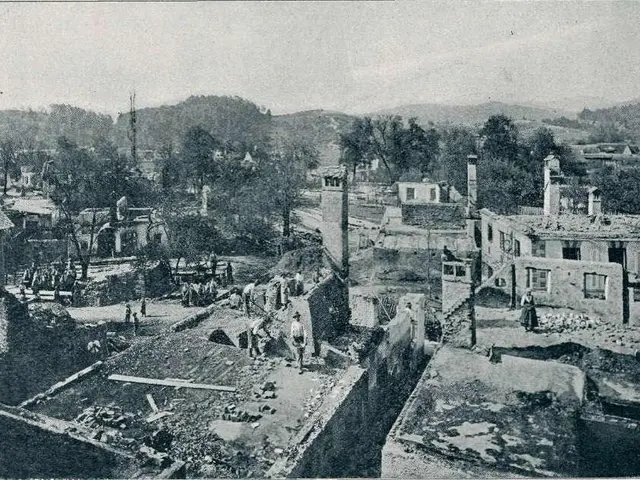
The village of Blatten, buried under a meter-thick layer of rubble, remains almost completely submerged with the exception of the church steeple. The approximately 300 villagers were evacuated after the rockfall, and the whereabouts of one local resident who was in the disaster area remain unknown [3].
Though the risk of an immediate catastrophic overflow has diminished, the Lötschental area remains a complex and ever-evolving situation. Officials are urging caution and practicality in dealing with the aftermath, ensuring the safety of residents while moving toward a rebuilding plan [4].
Sources:[1] ntv.de, Christiane Oelrich, dpa[2] news.com.au[3] swissinfo.ch[4] thelocal.ch
The Commission has also been consulted on the following issues: climate-change, science, environmental-science, and weather-forecasting, considering the unpredictable weather conditions in Lötschental.
Given the hazardous sports-betting landscape and the potential for sudden weather changes, it would be prudent to proceed with caution in these challenging times.
As the risks associated with the stagnant lake in Lötschental decrease, a focus on the long-term rebuilding of affected areas and strengthening of infrastructure could be beneficial for coping with future environmental challenges.
Evaluating the mechanisms of climate-change and glacier movements is crucial to better understand the factors contributing to such disasters and potentially mitigate their impact in the future.