Swollen lake situated in the Lötsch valley, Switzerland
Lötschental Struggles with Flood Risks as Glacier-Induced Lake Drains
Residents of Lötschental, Switzerland, find solace in the receding water level of a lake formed due to a glacier collapse. However, attention now turns to the weather forecast, as subsequent days could bring rain and glacier melt, potentially exacerbating the already unstable debris cone.
In the Valais Lötschental, the dammed mountain river Lonza is carving new channels through a massive debris cone obstructing its original course. At a press conference in Ferden, canton geologist Raphael Mayoraz reported that the water level behind the debris dam has dropped by approximately one meter.
Flotation barriers have been installed in the dammed water to prevent debris blockage and outlet obstruction. The water volume has decreased from approximately one million cubic meters to about 800,000 cubic meters, draining slowly over the debris cone. This reduction in water level is seen as a positive development, as it lessens the risk of the debris cone liquefying and causing more material to slide down into the valley.
Potential Hazard Scenarios
Forecasts predict several days of rain, along with glacier melt on neighboring mountains. Such conditions could destabilize the debris cone, heightening the risk of a debris flow. should such an event occur, rock, rubble, and mud could move down the valley, potentially endangering communities further downstream.
The debris cone itself is particularly unstable. Estimates suggest that one-third of the nine million cubic meters of material that accumulated in the valley after the glacier collapse is ice. no one can predict when or if the ice will melt, or if cavities might form in the cone, causing it to collapse.
Further rockfalls remain a concern as well, as the catastrophe was triggered by the collapse of rock material from the roughly 3000-meter-high Kleine Nesthorn. Under the weight, the glacier broke off last Wednesday and swept into the valley with massive amounts of ice, rock, and debris. There is still loose material at the collapse sites, suggesting that the Kleine Nesthorn has not stabilized yet.
Emergency Planning
The power plant in Ferden, about six kilometers downstream from the disaster area, isbeing prepared for larger water or debris flows. The operator has partially emptied the reservoir to create space and has stated that the dam could hold even under greater pressure. If a large amount of water accumulates, the alarm will sound when the reservoir reaches two-thirds of its capacity, as per Mayoraz's report.
Downstream villages of Gampel and Steg have been given time to evacuate due to the potential flooding risk. Unlike upstream, the river here is channeled through relatively narrow concrete canals that could quickly overflow in a flood. Residents have already packed their essentials and are ready to leave their homes at short notice, alerted via a warning app and sirens.
The water of the Lonza reaching the dam at Ferden is heavily polluted with sand and debris from the debris cone. Dredgers are at work in Gampel to deepen the drainage channels as these sediments settle further downstream.
Aftermath
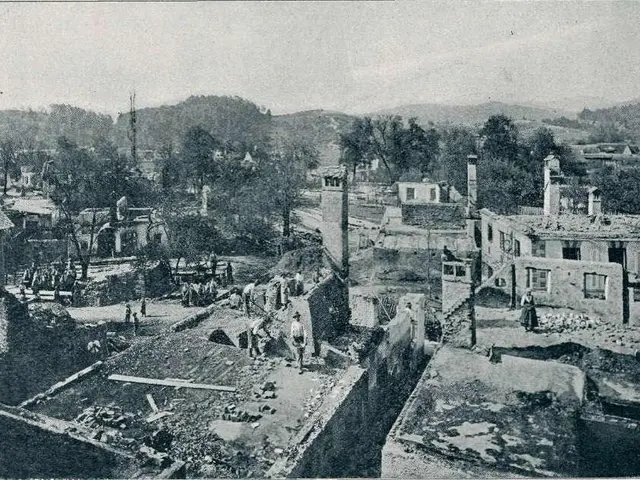
Rock, ice, and debris have almost completely buried the medieval village of Blatten, leaving only a meter-high layer of rubble. Even the church tower does not protrude. Most of the few houses that were spared have been submerged in the stagnant water of the Lonza. The approximately 300 residents were evacuated after the rockfalls, with one local resident still missing.
The residents are staying elsewhere in the valley or with relatives. Many are taking advantage of the help of psychologists, as reported by the Association for Psychological Emergency Aid in Upper Valais. They meet regularly, and the belief in a rebirthed Blatten has been voiced by Mayor Bellwald, who has promised to present plans for rebuilding shortly.
"We don't need pessimism and bureaucracy, but practical solutions," he said.
Sources: ntv.de, Christiane Oelrich, dpa
- Switzerland
- Glaciers
- Natural Disasters
In light of the historical significance of Blatten, mentioned in writing in the 15th century, it is hoped that efforts for rebuilding will successfully restore the once-thriving village. Ongoing monitoring, relief efforts, and emergency planning will continue to mitigate the immediate flooding risks, while long-term planning will address the challenges of glacier retreat and its consequences on regional water supplies and infrastructure.
- The Commission has also been consulted on the following issues: climate-change, environmental-science, weather, weather-forecasting, in light of the ongoing glacier retreat and related flooding risks in Lötschental, Switzerland.
- As the Commission ponders the implications of the catastrophe in Lötschental, concern arises over the potential impact of glacier melt and weather patterns on the stability of debris cones and the risk of subsequent debris flows.
- In the long term, environmental scientists must explore sustainable solutions to mitigate the effects of climate-change on glaciers, weather patterns, and the associated flooding risks in regions like Lötschental.