Swollen lake situated in Lötsch valley
Rising Concerns as Dammed Lake in Lötschental Drains
In the aftermath of the glacier collapse in Lötschental, Valais, Switzerland, the dammed lake created by the landslide continues to pose various risks, particularly in relation to rain and ice melt. The residents of Lötschental are breathing a sigh of relief as the level of the threatening lake drops significantly, but their concerns over potential floods remain high.
According to a press conference held in Ferden, the Lonza River, previously blocked by a large debris cone, is now carving channels through the accumulated material. The height of the lake behind the debris has decreased by one meter, as reported by canton geologist Raphael Mayoraz. Floating barriers have been installed to prevent debris from blocking the outflow and to hold back floodwaters. The water volume has decreased from approximately one million cubic meters to around 800,000 cubic meters.
The slow draining of the water over the debris cone helps reduce the risk of the debris cone liquefying and facilitating a large-scale debris flow. This was one of the primary concerns, as the unstable debris might collapse, releasing more rock, ice, and debris into the valley. The risk has diminished, according to Mayoraz.
However, the situation is far from stable, as several potential disaster scenarios loom on the horizon. The weather forecast is calling for rain and ice melt over the coming days, which could further destabilize the already unstable debris cone and increase the risk of debris flows. These events could pose grave danger to communities further down the valley.
Another concern is the debris cone itself, with experts estimating that a third of the nine million cubic meters of material that ended up in the valley is likely to be ice. The timing and nature of future melting events are uncertain, raising concerns about whether cavities may form in the debris cone, causing it to collapse. The debris cone remains very unstable, and venturing onto it would be a significant risk, Mayoraz warned.
Further rockfalls are also a possibility, as the collapse of material from the Kleine Nesthorn, approximately 3000 meters high, triggered the initial disaster. Loose material remains at the collapse sites, and continued erosion poses the potential for future debris flows.
In Ferden, operators are working to prepare for larger water or debris flows. The reservoir has been partially emptied to create space and strengthen the dam wall against increased pressure, according to experts. An alarm will be triggered once the reservoir is two-thirds full.
Lower-lying villages of Gampel and Steg, located near where the Lonza flows into the Rhone, have been given a window of time to evacuate due to the river's channeling through narrow concrete canals that could quickly overflow in a flood. Residents have already packed essentials and are prepared to leave their homes at short notice, alerted through a warning app and sirens.
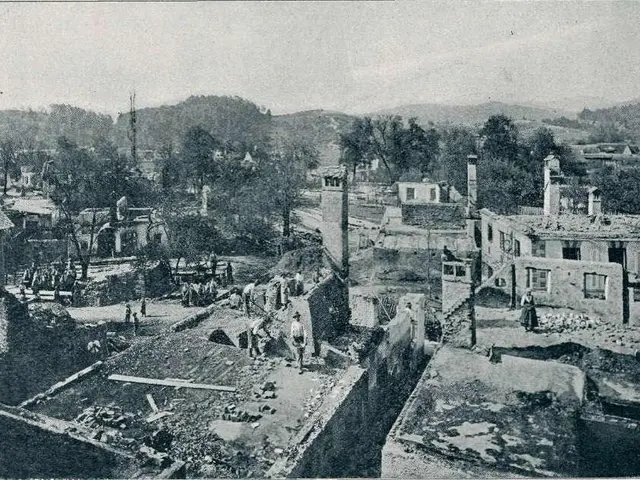
The water arriving at the dam in Ferden is heavily polluted with sand and debris from the landslide. Dredgers are working to deepen drainage channels in Gampel to address this issue. Blatten, first mentioned in the 15th century, has almost completely been buried under a meter-high layer of debris, with the church tower and many previously undamaged buildings now submerged in the stagnant water of the Lonza. The residents of Blatten, totaling around 300, are staying elsewhere in the valley or with relatives, with some taking advantage of psychological support offered by the Psychological Emergency Aid Oberwallis association.
Rebuilding plans are on the horizon, as promised by Mayor Bellwald, who encouraged practical solutions instead of pessimism and bureaucracy.
Sources: ntv.de, Christiane Oelrich, dpa
- Switzerland
- Glaciers
- Natural Disasters
- The Commission has also been consulted on the following issues: science, climate-change, environmental-science, and weather, with specific focus on weather-forecasting, given the potential impact of rain and ice melt on the unstable dammed lake in Lötschental, Switzerland.
- As the Commission deliberates on the best course of action, experts have emphasized the need for continued monitoring and prediction of weather conditions to minimize the risks posed by further flooding, debris flows, and potential collapse of the dammed lake in the region.
- In light of the ongoing concerns, it is crucial that the Commission and relevant authorities collaborate closely with environmental scientists and meteorologists to ensure effective assessment of the risks, and to implement measures aimed at mitigating the effects of climate change and enhancing overall disaster preparedness in Lötschental, Switzerland.