Following the glacier's collapse, the seawater is retreating.
In the Swiss canton of Valais, the Lötschental valley, a significant decrease in the water volume of the Lonza river has been observed following a series of dangerous floodwaters carving channels through a massive debris cone blocking its bed. Canton geologist Raphael Mayoraz, speaking at a press conference in Ferden, announced that the height of the lake behind the debris had dropped by a meter. Barriers have been set up in the impounded water to retain debris and prevent the outlet from being obstructed.
Mayoraz reported that the water volume has decreased from around one million cubic meters to about 800,000 cubic meters, demonstrating a positive development as the water drains slowly over the debris cone, reducing the risk of the cone liquefying and carrying large amounts of material downstream. The unstable debris, a concern previously, now poses a diminished threat.
However, weather forecasts predict rain and melting ice on surrounding mountains over the next few days, potentially destabilizing the debris cone and increasing the risk of a debris flow. Such an event could endanger communities further down the valley.
Experts estimate that approximately one-third of the nine million cubic meters of material that accumulated in the valley after the glacier collapse is ice. The fate and timing of its melting remain uncertain, along with the possibility of voids forming in the cone, causing it to collapse.
The catastrophe originated from the collapse of rock material from the approximately 3,000-meter-high Kleine Nesthorn. The rock material fell onto the Birsch glacier below, causing it to break off last Wednesday and rush down the valley with massive amounts of ice, rock, and rubble. Loose material persists at the break-off points, posing a continued risk of further rockfalls and debris flows.
Preparations are underway at the power plant in Ferden, about six kilometers downstream from the disaster area. The operator has partially drained the reservoir to create space and ensure the dam can withstand greater pressure. Should a large amount of water collect there, the alarm will sound once the reservoir is two-thirds full, providing notice to evacuate to the nearby communities of Gampel and Steg.
The water of the Lonza arriving at the Ferden dam is heavily polluted with sand and abrasion from the debris cone. As a precaution, excavators are being used in Gampel to deepen the drainage channels and prevent sediments from settling further downstream.
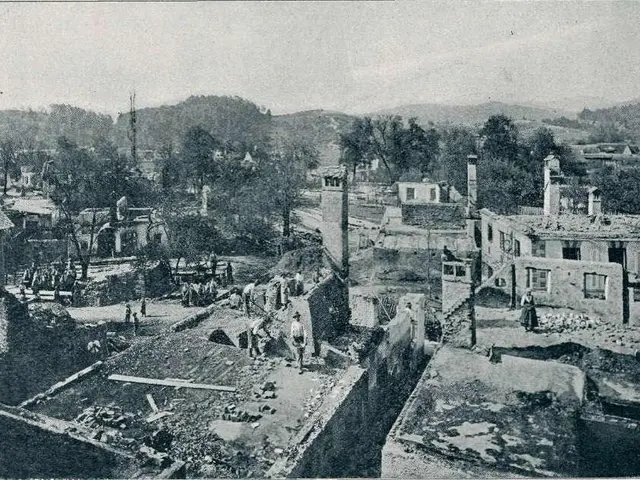
The Alpine village of Blatten, first mentioned in the 15th century, has nearly been buried under a meter-high layer of rubble at an altitude of around 1,500 meters. Even the church tower doesn't protrude. Most of the few houses that were spared have been submerged in the stagnant water of the Lonza. The approximately 300 residents were evacuated to safety after the rockslides. One local remains missing.
The inhabitants have found accommodation elsewhere in the valley or with relatives. Many are taking advantage of the help of psychologists, according to the association Psychological Emergency Aid in Upper Valais. Rebuilding plans with a time horizon will soon be presented by Mayor Bellwald, emphasizing the need for practical solutions rather than pessimism and bureaucracy.
Other environmental science studies are needed to predict the long-term effects of the changing volume of the Lonza river, considering factors such as climate-change and weather patterns.
The decrease in the water volume, while positively impacting the risk of a catastrophic debris flow, creates new uncertainties related to the melting of the ice in the debris cone and its potential consequences.
Weather-forecasting predictions of rain and melting ice pose a threat to the stability of the debris cone, which could lead to environmental-science issues such as debris flows and potential endangerment of communities further down the valley.