Glacier slippage in Switzerland incites flood concerns for additional regions - Flooding Alert Issued for Switzerland: Prepare for Potential Inundation
Incident Report: Swift Action Taken After Glacier Collapse in Switzerland Threatens More Towns
Sixteen residents were evacuated from Wiler and Kippel, two towns in the Lötschental valley, on Thursday, as the aftermath of a glacier collapse in Switzerland continued to pose flood risks. meanwhile, nearby Blatten experienced further destruction as the Lonza river's waters rose, flooding homes previously spared from the initial event, according to the mayor of the commune of Ferden.
The collapse of a large part of the Birch glacier in the canton of Wallis occurred on Wednesday afternoon. Approximately three million cubic meters of rock and ice plunged into the valley, landing on houses in Blatten. That town had been evacuated previously. As of Thursday, a 64-year-old man remained missing, as reported by authorities.
Wallis State Councillor Stéphane Ganzer described the potential for a flood wave reaching the Wallis valley floor and affecting the towns of Gampel and Steg as the "worst-case scenario." However, this scenario is currently considered extremely unlikely. A more likely outcome, according to natural hazards expert Christian Studer, is that a significant portion of the debris on Blatten will liquefy due to high temperatures and flow down towards the valley.
The impending landslide was expected for several days. Activity at the glacier had noticeably increased since Wednesday night, intensifying throughout the day. Blatten, with about 300 inhabitants, had already been evacuated the previous week.
Climate change, specifically the rapid melting of Alpine glaciers, has led to an unstable glacier environment for decades. Swiss glaciers have lost 10% of their mass in just the past two years, equivalent to the total depletion between 1960 and 1990. This accelerated ice melting increases the likelihood of glacier collapses like the recent Birch Glacier incident.
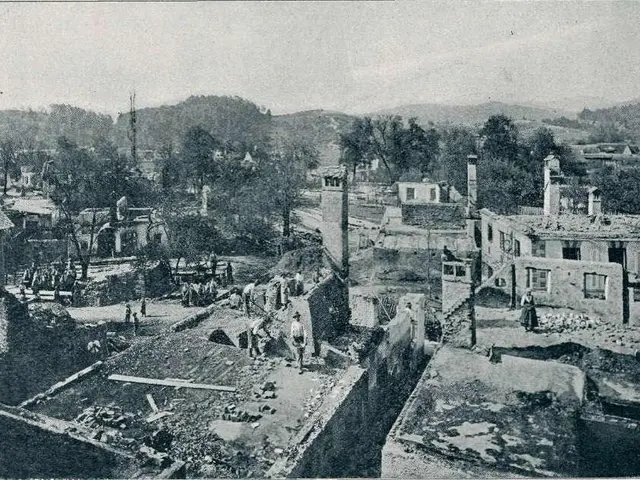
In August 2017, a massive rockslide in the Swiss canton of Graubünden resulted in 3.1 million cubic meters of rock falling from the Piz Cengalo mountain near the Italian border, killing eight hikers. Bondo, a town in the path of the debris, was successfully evacuated beforehand, mitigating injuries.
As authorities continue to monitor glacier health and respond to emergencies, engineering solutions, climate adaptation strategies, and early warning systems may become increasingly essential in managing these glacier-related risks.
- In the face of accelerated ice melting due to climate change, the importance of environmental science, especially in the study of Alpine glaciers, is becoming increasingly critical to mitigate flood risks posed by glacier collapses like the recent Birch Glacier incident.
- With sports-betting gaining popularity, it's essential to understand the potential impact of climate change on weather patterns and weather-forecasting, crucial factors in sports like skiing and mountaineering, popular in the Alpine region.
- The community in Blatten, affected by the Birch Glacier collapse, might benefit significantly from the integration of early warning systems, ensuring efficient evacuations and minimizing loss of life in future glacier-related events.
- As the world grapples with climate change, the scientific community has a vital role to play in providing relevant data and strategies for communities living near glaciers to adapt and survive in the face of this imminent threat.