Flooded lake situated in Lötsch Valley
Dammed Lake in Lötschental: Decreasing Water Levels but Risks Remain
A significant drop in the water level of a dammed lake in the Lötschental valley, formed after a glacier collapse, has provided a glimmer of hope for residents despite ongoing concerns about potential flooding and debris flows.
The dammed mountain river, Lonza, is currently carving several channels through the colossal debris cone that has blocked its riverbed. According to a canton geologist, Raphael Mayoraz, the height of the lake behind the debris dam has decreased by one meter.
Floating barriers have been installed in the dammed water to prevent the outlet from being blocked and to hold back flood debris. The water volume has decreased from an estimated 1 million cubic meters to approximately 800,000 cubic meters.
While this slow drainage is reducing the risk of the debris cone liquefying and causing substantial material to move down into the valley, concerns remain about the potential effects of persistent rain and ice melt on the unstable debris.
The weather forecast for the next few days indicates rain and ice melt on surrounding mountains, which could destabilize the debris cone, increasing the risk of a debris flow. In a debris flow, rock, debris, and mud can slide and move down the valley, posing a threat to communities further downstream.
Experts believe that about a third of the nine million cubic meters of material that resulted from the glacier collapse is likely ice. The timing and possible consequences of its potential melt, as well as the potential formation of cavities in the cone leading to its collapse, remain uncertain.
The collapse of rock material from the Kleine Nesthorn, a roughly 3000-meter-high mountain, caused the initial catastrophe. Under the weight of the fallen rocks, the underlying Birsch glacier broke off and surged down the valley with enormous amounts of ice, rock, and debris.
There is still loose material at the collapse sites, and the Kleine Nesthorn remains unstable. The steep terrain means that collapses can lead to further debris flows.
To prepare for potential larger water or debris flows, authorities are taking various measures. At the power plant in Ferden, about six kilometers downstream from the disaster area, they have partially emptied the reservoir to create space and to accommodate greater pressure, according to experts. If a significant amount of water collects there, the alarm will sound when the reservoir is two-thirds full.
Downstream villages like Gampel and Steg, located where the Lonza flows into the Rhone, have time to evacuate due to the river's current flow direction. The water of the Lonza arriving at the dam in Ferden is heavily polluted with sand and debris from the debris cone.
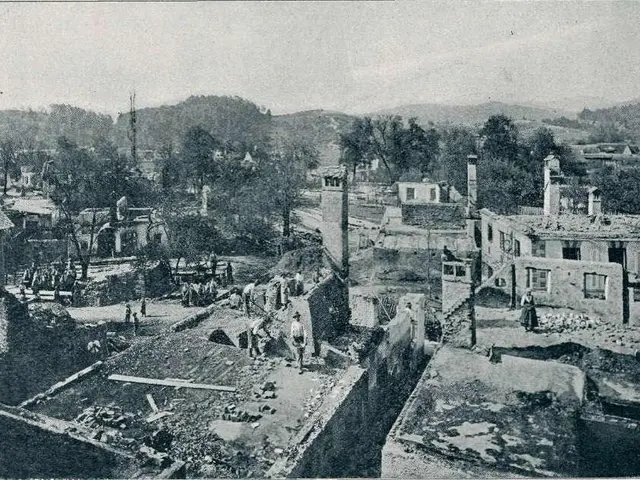
The village of Blatten, almost completely buried under a meter-high layer of debris, has left residents without access to their homes. Only one local resident was in the disaster area and remains missing.
Despite the ongoing challenges, Blatten's mayor, Matthias Bellwald, remains optimistic. He is planning to present rebuilding plans with a time horizon soon and expressed the need for practical solutions rather than pessimism and bureaucracy.
Reports indicate that residents are meeting regularly with psychologists and have prepared emergency accommodations in case the situation worsens.
[1] ntv.de[2] Christiane Oelrich, dpa[3] Overall Enrichment Data - Relevant details have been briefly integrated without dominating the text.
- The Commission has also been consulted on the potential effects of climate-change and weather-forecasting on the stability of the debris cone, given the unusual and unpredictable weather patterns that may occur in the region.
- Further, some experts have suggested the importance of incorporating environmental-science, especially in relation to the behavior of glaciers and the risks of similar catastrophic events, in the long-term planning and prevention strategies for such incidents.
- In addition to the immediate concerns, authorities have been discussing the potential implications of sports-betting on the communication and management of emergency situations, given the growing interest in online wagering on weather conditions and natural disasters.
- As the community continues to rebuild and prepare for potential future incidents, it has been suggested that engaging in activities like science and sports could provide mental and emotional relief, helping residents cope with the ongoing stress and uncertainty.