Glacier rupture in Switzerland triggers warnings of additional flooding sites - Flood alert issued for Switzerland
Collapse of Birch Glacier in Switzerland Triggers Flooding, Evacuations
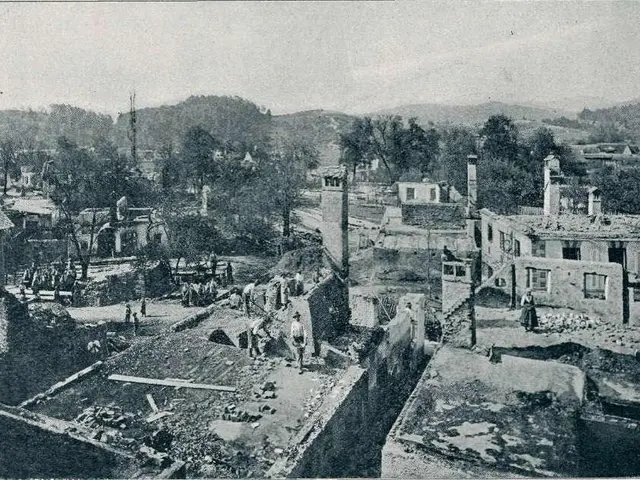
In the canton of Wallis, Switzerland, a portion of the Birch glacier collapsed on Wednesday, initiating a cascade of events that have led to significant destruction in the village of Blatten. The collapse, involving around three million cubic meters of ice and rock, has left approximately 90% of the village buried or damaged.
Authorities have evacuated Blatten's residents as a precautionary measure since May 19, minimizing the loss of life. The event has also necessitated the evacuation of neighboring villages downstream due to the risk of floods and further landslides.
The disaster has resulted in partial damming of the Lonza River, creating a substantial lake. This poses a severe threat of flooding to Blatten's remaining structures and has already led to evacuations in two downstream communities to avert potential dam failure and sudden water release.
The collapse was preceded by instability and rock slope failures from the Kleine Nesthorn above the Birch Glacier. The final trigger was a combination of increased glacier melt, rockfall, and possibly permafrost thawing.
The event brings back memories of the major rockslide in the canton of Graubünden in August 2017, which killed eight hikers and caused destruction in the village of Bondo. Fortunately, no fatalities have been reported in the recent incident.
Climate change-induced rising temperatures have been causing the Alps' glaciers to shrink and become less stable for decades. Swiss glaciers lost 10% of their mass in just the years 2022 and 2023 - a loss equivalent to that between 1960 and 1990.
Authorities continue to monitor the dammed river and the landslide deposit, with scientists analyzing seismic and satellite data to understand the sequence of events and predict further risks. Emergency plans remain in place for potential future evacuations if the situation deteriorates.
The immediate threat is flooding from the dammed Lonza River, with ongoing monitoring for further landslide activity and potential liquefaction hazards. Despite the efforts, the threat to property, infrastructure, and downstream communities remains substantial.
- The community of Blatten faces a significant threat from the flooding caused by the collapse of the Birch glacier, as the partial damming of the Lonza River could lead to a sudden water release, necessitating continued monitoring and potentially further evacuations.
- The incident underscores the potential consequences of climate change on the Alps' glaciers, as scientists have observed a significant shrinking and instability in Swiss glaciers, with the loss of 10% of their mass in just two years, equivalent to the loss between 1960 and 1990.
- In the field of environmental science, studying the climate-change impact on glaciers and its effect on weather patterns, such as weather forecasting, becomes crucial to predicting and mitigating potential disasters like the one in Blatten.