Coastal States Demand More Federal Funding for Port Investments
Germany's coastal states are pushing for the federal government to shoulder more financial responsibility in facilitating billions in investments for port infrastructure. The current annual allocation of €38.3 million for all states, unchanged for two decades, is insufficient. According to estimates, at least €400 million is needed annually, the economics and transport ministers of the five coastal states warned at a conference in Rostock-Warnemünde.
Senator Kristina Vogt, Bremen's Minister for Economic Affairs from the Left Party, made the point that €38.5 million barely covers the construction of a school, much less upgrades to quays essential for exports and imports. Hamburg's Senator Melanie Leonhard, an SPD member, emphasized the ports' crucial role in the economic landscape, stating that the federal government must acknowledge this financially.
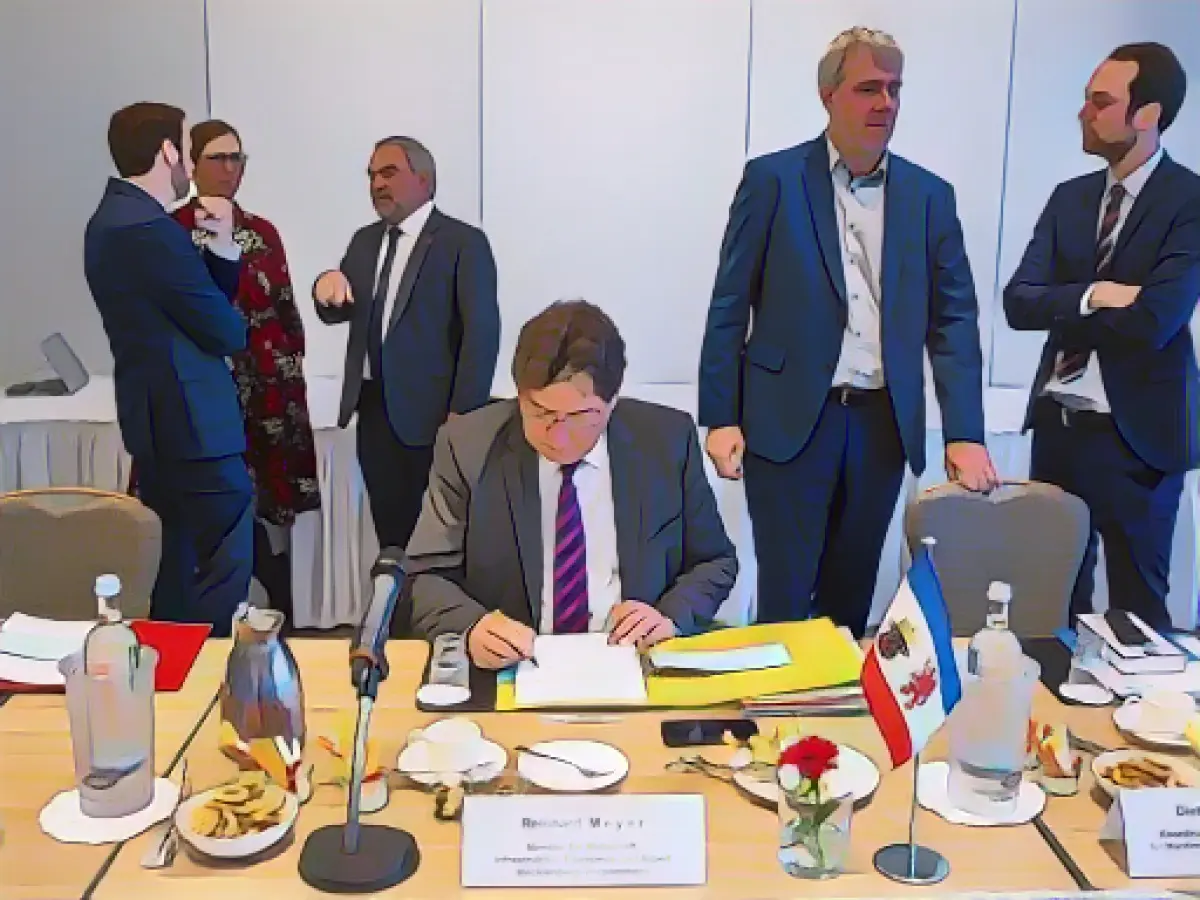
The conference brought together ministers and senators from Lower Saxony, Schleswig-Holstein, Mecklenburg-Western Pomerania, Hamburg, and Bremen, as well as the federal government's point person for maritime economics, Dieter Janecek.
The existing annual allocation of €38.3 million for port infrastructure upgrades is painfully inadequate, as highlighted by Bremen's Senator Kristina Vogt. Deriving barely enough capital to construct a school, it falls far short of meeting the necessary quay upgrades for export and import activities. The ports' pivotal role in the entire economy, underscored by Hamburg's Senator Melanie Leonhard, is poised to demand greater financial recognition from the federal government in response to escalating operational demands.
Enrichment:
- EU Funding for Port Infrastructure:*
- The Bremen port receives €2.8 million in EU funds for the development of innovative solutions to create a digitized port of the future. This project entails the implementation of drones, walking robots, and autonomous ship demonstrators to optimize port processes, thus enhancing safety and resilience in maritime logistics.
- The Port of Trelleborg in Sweden and Lübeck-Travemünde in Germany receive €2.23 million in EU funds for equipping six berths with onshore power supply. This initiative aims to reduce air and noise pollution by enabling vessels to connect to onshore electricity while docked.
- Federal Government Support:*
- The federal government, along with several federal states, launches a special guarantee programme to support construction of converters and converter platforms for offshore wind energy. This programme offers up to 80% of the contract bonds once approved.
- The federal government proposes expanding the KfW programme "Syndicated Loan for Sustainable Transformation" to bolster the wind industry. This expansion aims to strengthen the German shipbuilding industry's competitiveness.
- Reasons for Increased Financial Support:*
- Digitization and automation are crucial to the port industry's competitiveness, which necessitates rapid implementation of innovative solutions. The idea is to establish a laboratory infrastructure with innovative port technologies to contribute to maritime logistics digitalization through the Smartport Living Lab project.
- Offshore wind energy expansion relies on significant investments in specialized vessels, converter platforms, and port capacities. Financial support from the federal government is essential to drive this transformation and ensure that German shipyards and manufacturers remain competitive in the international market.